
Find it before it fails.
A DFA device in the substation reads each feeder's current and voltage. It recognizes failing clamps, arcing switches, tree contact and misbehaving protection, then tells crews what to look for and where to start.

US fleet, live from DFA Data as of October 30, 2026.
Named by utilities in their own reports, articles and filings
- Pacific Gas and Electric
- Southern California Edison
- Pedernales Electric Cooperative
- Mid-South Synergy
- Bluebonnet Electric Cooperative
- Concho Valley Electric Cooperative
- Central Electric Cooperative (Oregon)
- Pickwick Electric Cooperative
- Arizona Public Service
- UK Power Networks
Real failures, found by crews who knew where to look
Every case comes from a field investigation on a working utility circuit, published in a paper, article or talk.

Two blinks a day apart led to a charred crossarm beside a pine forest
Nobody lost power for more than a blink. DFA matched the two faults, and the crew found a conductor burning into its crossarm six spans from the prediction.

Six faults in nine hours, no outage, no calls, and a branch removed
A hanging branch tripped a recloser six times without an outage. DFA grouped the faults into one report, and a targeted patrol found it.

Same fault twice in six days, and a dead squirrel found within hours
A breaker trip interrupted more than 1,200 customers twice. DFA linked the two faults within a minute, and the report took the crew to one pole.

Failing clamps, caught arcing and replaced
A failing clamp can arc for weeks before it burns through. Three finds show how DFA turns that warning into a work order.

A circuit lockout explained, and the grass fire it started found
SCADA showed the whole circuit locked out. DFA said why, and the crew went to the predicted span and found arc marks and burned grass.

A failing capacitor switch, found and fixed the same day
The arcing barely moved the current. DFA classified it, sized the bank, and the crew arrived knowing which switch had failed.
From waveform to work order
No line sensors and no field installs. One device per feeder in the substation, and reports written for the people who act on them.
Listen at the substation
Each DFA device connects to the feeder's existing CTs and PTs, wired like a relay. It records current and voltage continuously at high resolution, so it sees a few amperes of arcing on a circuit carrying hundreds.

Recognize what is failing
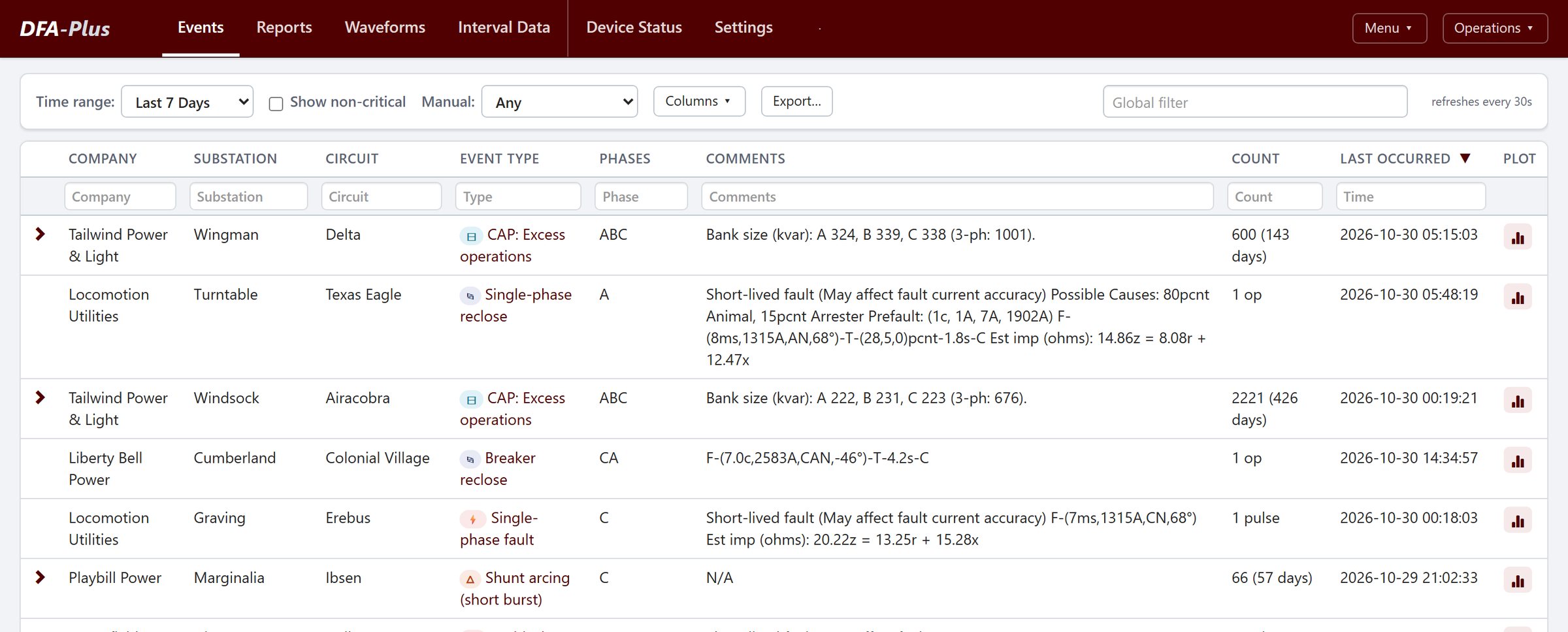
Software on the device classifies each event as it happens, typically within a minute or two: faults and how they ended, series and shunt arcing, capacitor trouble, recloser and breaker operations. Thousands of recordings become a short list in plain language.
Say what, where and how often
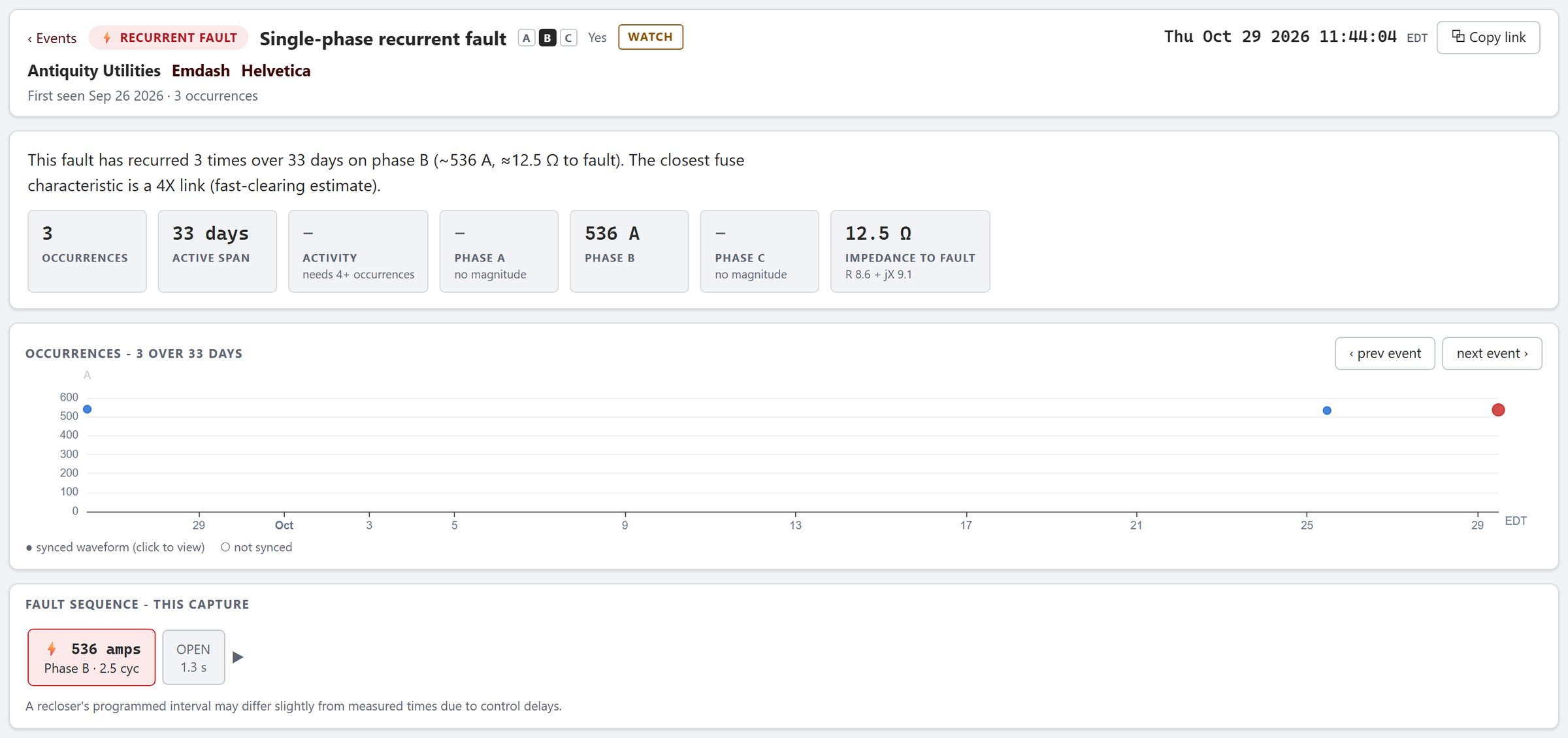
Each report gives the phase, the fault current, the impedance to the fault, the closest fuse size and every earlier occurrence on that circuit. Recurring faults are grouped, so the second blink is a work order, not a mystery.
Send the crew to the right span
Operators enter DFA's fault current into the circuit model, ping meters, or match the operating recloser, then dispatch. One cooperative reports that DFA fault currents put its crews within four pole spans 80% of the time. The same report opens on a phone in the truck.


The failures that start small
Many failures give hours, days or weeks of electrical warning before they cause an outage. DFA turns that warning into a report.
Failing clamps and switches
Series arcing in a load-carrying connection, with the phase and the load beyond it.
Leakage arcing
Shunt arcing to ground across insulators, bushings and vegetation.
Recurrent faults
The same fault at the same place, from trees, animals or a broken insulator, grouped into one report.
Capacitor problems
Failing vacuum switches, restrike, blown fuses and dead phases on switched banks.
Cable and termination failures
Self-clearing pulses that never trip a breaker, recorded every time they happen.
Failing arresters
Escalating short-lived faults that point to an arrester before it fails.
Protection misoperations
Reclosers that pump, trip on load or fail to lock out; breakers that trip for faults downstream.
Conductor slap and wires down
Fault-induced conductor slap, and faults that leave a conductor energized on the ground.
Built for the people who act on it
Operations and dispatch
Know the likely cause and location before the first call comes in.
Line crews
Patrol a few spans, not the whole circuit, and arrive knowing what to look for.
Protection engineers
See every trip, reclose and lockout, and catch devices that misoperate.
Reliability and vegetation
Fix the recurring blink before it becomes a sustained interruption.
Wildfire mitigation
Find ignition sources early, from arcing clamps to slapping conductors and branches on lines.
Asset management
Move capacitors and other equipment from calendar inspections to condition-based maintenance.
DFA has so far been the single most important operational technology we have implemented which has given us wins in the shortest amount of time.
Dr. Comfort Manyame, senior manager of research and technical strategy, Mid-South Synergy. Texas A&M Engineering Experiment Station, 2018.Four decades of research, a decade in daily use
DFA grew from waveform research at Texas A&M that began in 1978 and from an EPRI program that began in 1997. Utilities from Texas cooperatives to PG&E have deployed it, and many have published what it found.